Posts

Special Collections Internship at the University of Central Florida

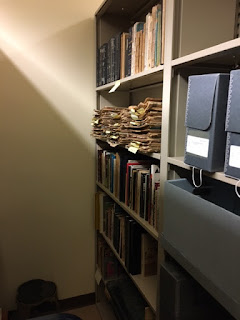
Week 4: The Inside Scope of What I Do! In this internship, I am learning how to be an archivist and what to expect if I want to specialize as a digital archivist. The Special Collections staff is small compared to other institutions so they do a little bit of everything. In other words, they do not necessarily concentrate on one task forever rather they work on the preservation of a collection and at the same time, they may work on digitization for another collection. From past blogs, I have mentioned that I have been organizing materials. Video 1 gives an overview of my daily tasks and my whereabouts. As a historian, this internship has exposed me to the ins and outs of what professional archivists do before I come in and do research. I am seeing it from another perspective, the back-story. In addition, the task I am doing will help me to adapt to places where the archival institutions are not organized so I have the skills needed to navigate and find the materials I am looking for...

Special Collections Internship at the University of Central Florida

Image
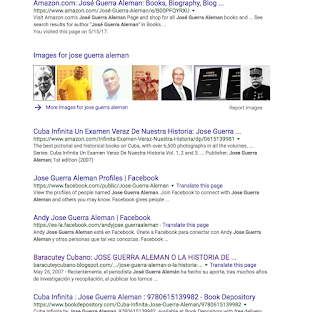
Week 3: VIVA CUBA! Organizing his masterpiece! I had to work with his drafts of the four encyclopedias called Cuba Infinita. He completed them in 2008. He had papers with the information and photos. Each of the pages had numbers. However, most were not in the right order. I had to use the published books as a guide to place them in order. I got to see the changes and edits he made. For instance, in Volume III and on page 208, the first photo to the left had additional words to its caption. The video presents a usual day at the Special Collections seen below. I believe his work on the encyclopedias were inspired and guided by an eight-volume encyclopedia of Cuba. The books are organized similarly to Alemán: poems; prose, theater; novels and costumbrism; history; arts and society and philosophy; prose of war; geography and folklore and education and economy; municipals. Although he divided his encyclopedias by decades, his work follows under the categories above...

Special Collections Internship at the University of Central Florida

Image
Week 2: The Man behind the Research! Learning About the Man!           This week I continued to delve into the boxes. Jose Guerra Alemán was a collector of anything that dealt with Cuba’s history, literature, and other subject matters. He had a tremendous amount of his own notes from books, playwrights, and other people’s works. From box 1 to 5, I basically went through each paper written mostly in Spanish and I organized them according to their rightful category that I created-  Folder 1: Civic life where it will contain series of geography, music, literature, and history; Folder 2: Contributing works will contain series of his texts (published and unpublished), his notes, and his manuscripts of his books; Folder 3: Influences will contain series of authors, poets, and scientists that he used and inspired; Folder 3: Photos, memorabilia, letters will contain series of his professional materials (research) and personal (family-related).  I learn...

Special Collections Internship at the University of Central Florida

Image
Week 1: Discovery  Landed to a New Place! Hello to all!    I have finally found an internship where I can work at. I am excited for this opportunity at the University of Central Florida Special Collections. First of, you all may be wondering who am I. Well, I am Samuel Ortiz, a graduate student from the University of Central Florida. I am in the traditional History track. In addition, I want to be able to see another perspective of what a historian can do. I mean seeing history at different perspectives from a historian angle is what scholars are supposed to do in their research. I wanted to apply and gain new skills other than an academic professor. In that case, I have always been drawn to archivist work, especially digital. My first hope was to be able to explore in that area. In reality, the staff told me that there are not many projects that follow under the title of digital, but they were willing to provide me an idea of what they already ha...
Image
Struggles of hearing unheard narratives         The past few years I have been doing research on four indigenous women: Sacagawea, Kateri Tekakwitha, Pocahontas, and Doña Antonia. My investigation was how these women navigated through marriage among their own communities and from the colonizers as a means to assert their identities. I wanted to show their humanity because society has placed them as symbols or objects; however, they were people who had challenges and are more than just stories or representation. My first question to all of you is "Do you think that these women asserted their identities even when they were colonized by mostly white men?" My second question is "Why do we remember these women according to cultural stereotypes rather than focusing on their individualized identity or identities?

Integration with the digital and the traditional

Image
Source:  http://www.digitalmeetsculture.net/tag/digital-humanities/ In the digital age, the first thought is that the technologies will replace humans' minds. However, in academia the digital humanities are needed in both the digital applications and in this case, the histories. Both shape the way scholars think and reason. The integration provides new research questions and new scholarships form. 

Course Reflection

The course was enriching because there was information I was exposed to that I would not normally have known if it was not for this class. For instance, in the book Content Strategy for the Web, I learned a new term and job position called content strategist. This person’s specialty is to know the information, but also to know how to persuade the content to other who may be unfamiliar with the product or message. In the same book, I learned what magic layer means and its purpose. Magic Layer seems as though it comes after the brainstorming process and then the person starts to apply the ideas. This layer is feared from many people because it tests their creativity and challenges them to not rely on themselves rather executing the impossible with collaborators. I could relate the challenge this process called the magic layer can be, especially when I began my rhetorical analysis and finding content for the webpage contribution. I needed to allow people to look at my work so I could in...